
A quick primer of how many solar panels you need to camp off-grid… (Rerun Feb 2023)

Hey Mike
One of the RVs I’m looking at has 150 watts of solar panels and a 100 amp-hr lithium battery. The salesman says that a 150-watt panel is plenty to keep my battery charged for a few days of dry camping. It also has a new 12-volt DC refrigerator, and I’ll need to use a CPAP machine at night. Is this guy correct, or is he blowing sales smoke up my skirt? —Alfonso

Dear Alfonso,
Ah, yes… This is a case of over-promising and under-delivering. Either he has no idea how solar works, or he’s just lying to make a sale. Let’s look at the numbers to see how this actually works.
How much battery storage does it have?
As I’ve noted many times here, a lithium battery can be discharged down to 0% State of Charge (SoC) thousands of times without damage. To calculate available energy we just need to multiply 12 volts times 100 amp-hrs to see that it equals 1,200 watt-hrs of energy.
What about AGM or Flooded Lead acid batteries?
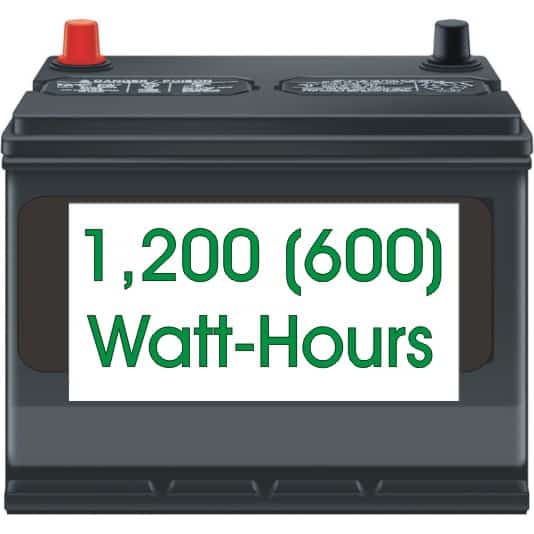
Of course, if you had a 100 Amp-hr flooded cell or AGM battery, they should only be discharged down to 50% State of Charge for best life, which would be 600 Watt-hrs of available energy.
How much energy will a 150-watt solar panel provide?

The general rule of thumb is that each 100 watts of solar will be able to provide between 300 and 400 Watt-hrs of charging energy per day, depending on cloud cover, angle of the sun, and length of day. So if we multiply 1.5 times 300, that equals a minimum of 450 Watt-hrs of charging per day, and possibly as much as 1.5 times 400 which equals 600 Watt-hrs per day in a sunny climate. Let’s use 400 Wh per day to account for real-world losses.
How fast will that charge the battery?

With everything turned off in your RV, that 150-watt panel will take at least 3 to 4 days of sun to completely recharge a 100 Ah lithium battery. That’s because 1,200 Wh of battery divided by 400 Wh per day of charging equals 3 days of time.
How much energy will that refrigerator use?
Of course, this depends on a lot of variables. But my experiments with 8- and 10-cubic-foot 12-volt compressor refrigerators have shown that you’ll need around 900 watt-hrs per day to keep it running. So with a 1,200 watt-hr (100 Ah) Lithium battery, it will drain the available power in a less than 2 days. Add a CPAP machine and a few lights and that 100 Amp-hr battery could be dead by the first morning.

Can 150 watts of solar panels keep up?
No, because it can only replace 400 to 500 watt-hrs per day. So, that might extend the refrigerator by another half day of running. And that’s barely enough energy to replace what a CPAP machine needs overnight!
So how much battery and solar do I really need?
If you want to dry camp (boondock) with a 12-volt DC refrigerator and CPAP machine for several days (let’s assume the CPAP machine will need 200 watt-hrs of energy per night), at a minimum you’ll need a second lithium battery, which is 200 Amp-hrs or 2,400 Watt-hrs of storage. But 400 Amp-hrs would be better.
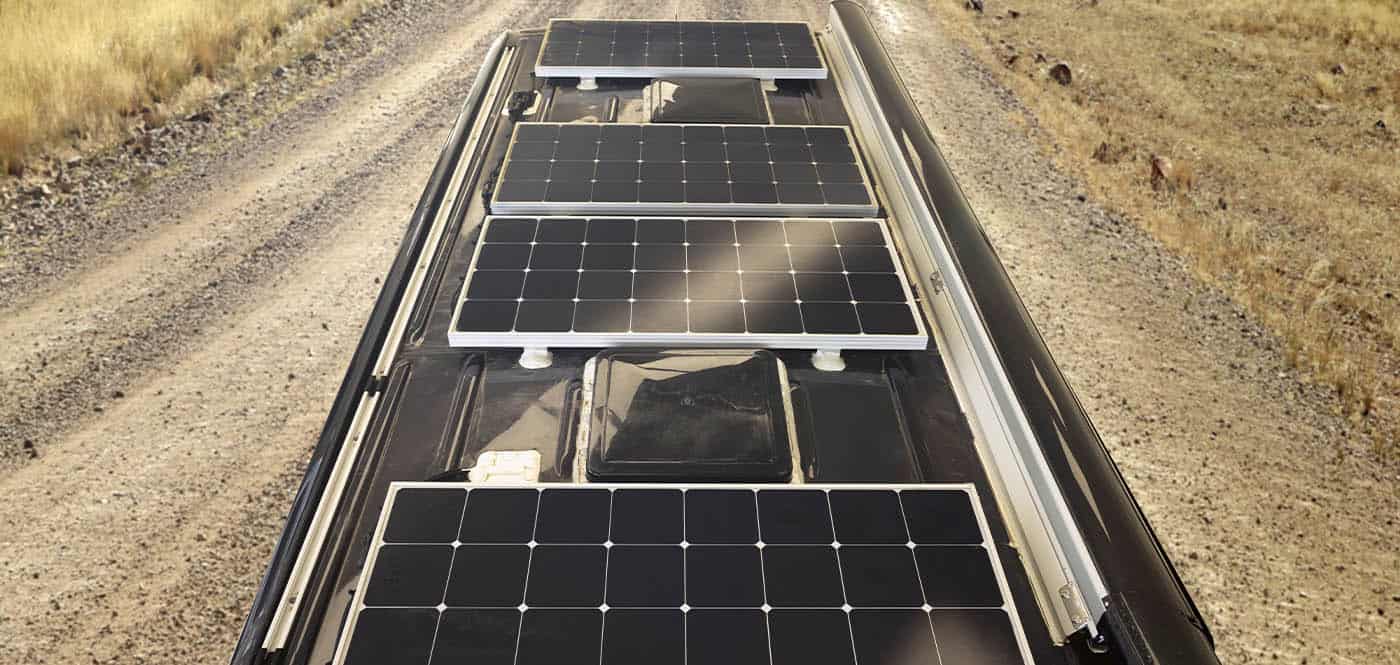
And you’ll also want at least 600 watts of solar, which could provide 2,400 Watt-hours of charge per day. This would allow the sun to completely recharge your batteries in a day. Even if the sun doesn’t shine, you’ll still have at least 2 to 3 days of stored battery power.
Caveat emptor.…

Just like any other purchase, you’ll want to research the claims made by the salesperson. I’ll be doing more in-depth studies of solar panel and battery selection for boondocking, so stand by for more data. But in the meantime, I can tell you that 150 watts of solar panel and 100 amp-hrs of lithium battery storage will not be enough for your camping expectations.
Remember that electricity is a useful and powerful force, so we all need to pay attention to safety precautions while using it.
Let’s play safe out there…. Mike
