
Thermal Magnetic breakers are a thing of beauty, but often misunderstood 🙁 (June 2023)

Dear Readers,
The amount of misinformation posted on Facebook is legendary, so please don’t take advice from just any FB “electrical expert.” It seems a bit like the original Firesign Theatre album, “Everything You Know Is Wrong”!

You should be aware that all of my RVelectricity articles are fully peer-reviewed by my colleagues – many of whom are highly skilled in electricity and code. Nope, I can’t get away with publishing incorrect information for long, so you can trust what I post. And when I do make a mistake, I admit it and make a quick correction. This stuff gets complicated!
Here’s what started this thread on a Facebook Group (not mine)…
I want to convert my 30 amp motorhome to 50 amp. Can I just put in a larger circuit breaker as someone said to do? (WRONG)
One of the answers (that’s wrong)
A good 30-amp circuit breaker takes 6.5 hours at 50-amp flow to trip. And yes, the larger breaker can source even more. If he is tripping the breaker and wants it fixed that would be a different issue. (WRONG)
Another answer (that’s also wrong)
A 30-amp circuit breaker will trip instantly as soon as it goes over exactly 30 amperes (WRONG)
So, what’s right?
First of all, NEVER put in a higher-amperage circuit breaker than the original one that the wiring will support. So no swapping in a 50 amp breaker for a 30-amp one. That’s a recipe for disaster!
Circuit breakers that you would find in your residential, campground or RV travel are all thermal/magnetic overcurrent protection devices. That is, the breakers are really two protection devices in one.
Divide and conquer
Inside of these breakers are two different ways that they can “trip” or “clear the fault” – as it’s called in the trade.
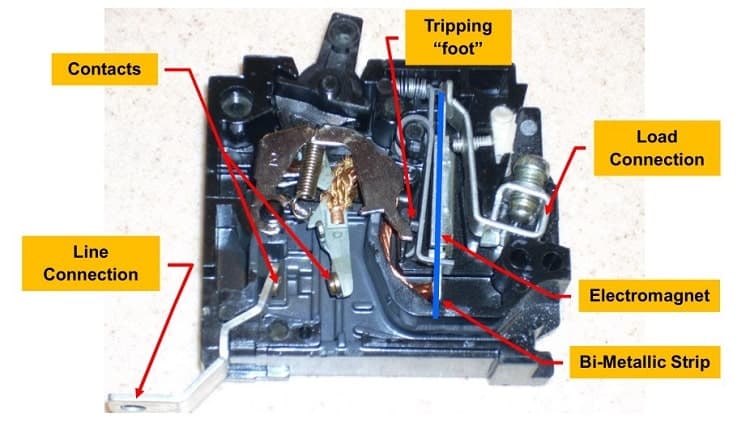
First, there’s a bimetal strip that gets hot if you draw more current than the breaker is rated for (up to 5x the breaker rating). When it gets hot enough from a sustained overload, it causes the spring to trip a lever and open up the contact.
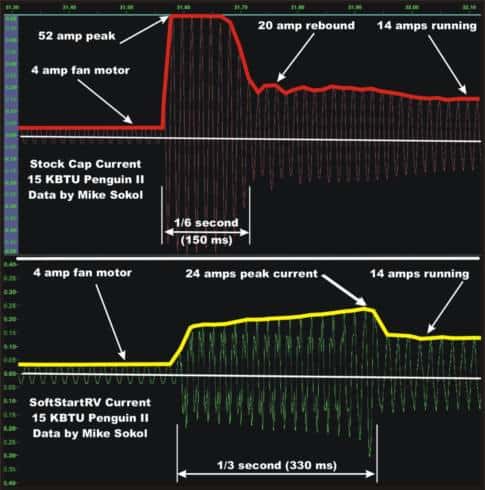
This is what allows the circuit breaker to provide you with enough power for momentary current surges like what’s required by an air conditioner compressor starting up. For example, above is one of my High Rate Data Logger (HRDL, like in “turtle”) curves for reference that shows just how much extra surge current is needed to start an air conditioner with the stock starting capacitor as well as the SoftStartRV controller. Without a thermal delay, any normal air conditioner would trip a 30-amp circuit breaker every time the compressor started up.
How long does a breaker take to trip with a moderate overload?
Actually, it takes a lot longer to trip than one might think…. Let’s look at a standard Class B OCPD (Over Current Protection Device) Trip Curve for example.
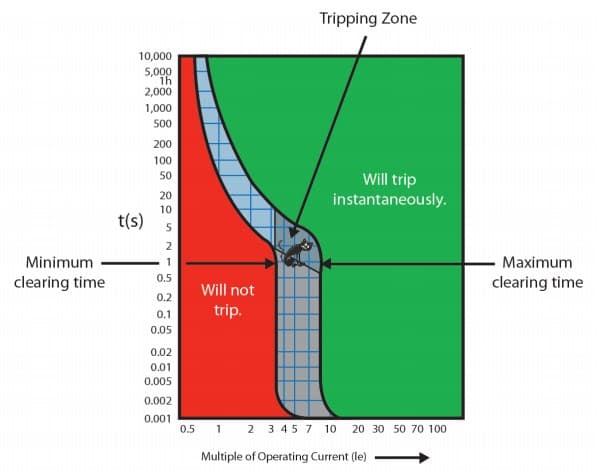
The bottom axis show you the amount of current in multiples of the rated amperage. So, for a 30-amp breaker, 1 would show you the trip time at 30 amps, 2 would show you the time at 60 amps, and 3 would show you the time at 90 amps.
The vertical axis shows you how long the time window is in seconds. So 60 amps of current through a 30-amp breaker should trip in between 5 and 20 seconds. At 1.5 times the rated 30 amps of current (45 amp overload), that same breaker could take anywhere from 30 to 200 seconds to trip.
But wait, there’s more!
Take a look at my chart showing how quickly a circuit breaker will clear a short circuit. I gathered this data myself using HRDL running at 48,000 times per second and 24-bits resolution. I create my own diagrams using data from my FunkWorks Lab whenever possible.
Here’s what a bolted short circuit looks like

Once you get above 4 times the rated current (in this case 120 amps from a dead short-circuit), the magnetic tripping part of the circuit breaker kicks in (literally). There’s an electromagnet that slaps a little hammer against the latch, causing it to open very rapidly. So, if you look at the curve above the number 4, you’ll see that this circuit breaker could “clear the fault” in anywhere from 0.002 seconds (2 milliseconds) to around 1 second. This is the big spark you see when you accidentally short out a wire with a screwdriver.Here’s what a contact short circuit looks like.
Here’s what a contact short circuit looks like
Here’s what it looks like when you short out a 100-foot length of 10-gauge copper fed by a standard 30-amp circuit breaker. Yes, that’s me in my lab doing an experiment to demonstrate just how fast circuit breakers trip on a short circuit. And, yes, it should be faster than the blink of an eye at maybe 15 milliseconds (0.015 seconds) or so.
What does this all mean?
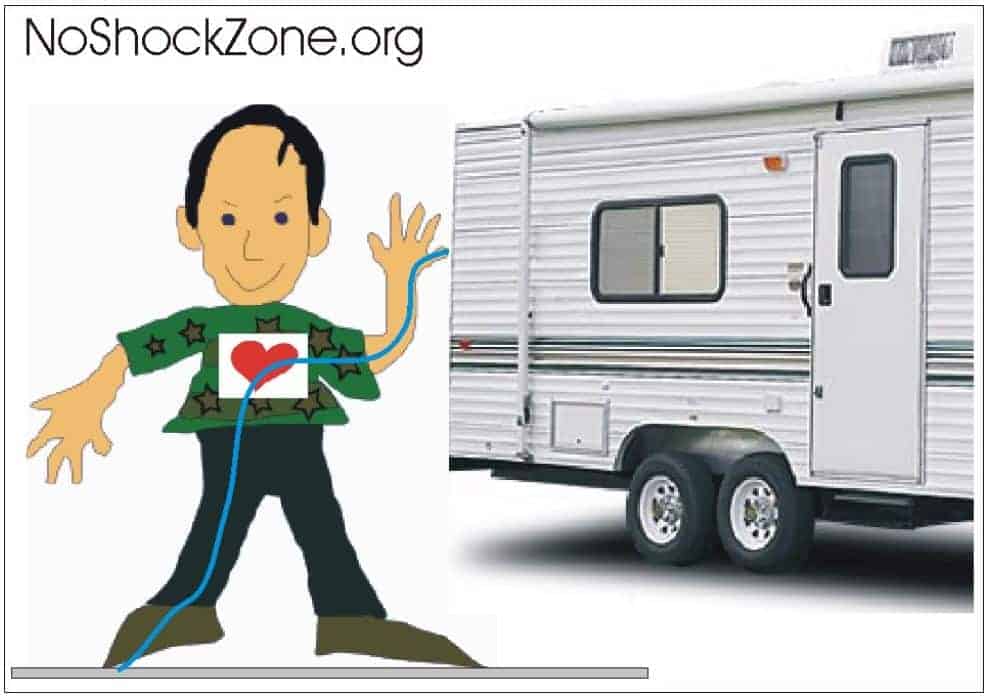
Well, circuit breakers are there to protect your wiring, not your heart. Their job is to prevent either a moderate overcurrent from heating up the wiring enough to start a fire, or clearing a short circuit, which could dump hundreds of amps through a wire and cause it to melt or even vaporize. GFCIs (ground-fault circuit interrupters) are there to protect you (and your heart) from more than the 5mA of current that’s needed to trip them. But that’s a different story altogether.
Kids, DON’T try this at home…
I’m doing these short-circuit demonstrations in the safest way possible, and I have 5 decades of experience to help keep me safe. So please, DO NOT try to replicate any of my experiments on your own. Yes, these are very dangerous.
Let’s play safe out there…. Mike

Another thing I often hear is when there is a fire people will say “the circuit breaker should have tripped and prevented the fire” and they blame the breaker. There are plenty of ways an electrical fire can start without tripping a circuit breaker.
So true!
Don’t crush that dwarf, hand me the pliers…..
🤣🤣🤣
Thanks again Mike for a very informative article. I’m really surprised it takes so long for a breaker to trip at its rated current (>>10 sec according to your chart). I always knew there had to be a delay but I thought it was much shorter than it actually is. In another example, my AC compressor has a 30A double pole (240V) breaker. The LRA rating is 79 Amps. According to your chart it would trip in something like 2 seconds which is fine since the start-up transient lasts for less than 1 sec. It all work out quite well in practice. Thanks also for your very well done high speed pictures of transient start ups. I struggle making sense of inrush measurements made with clamp on Amp meters but there is nothing like a real graph of current vs time! Nice work Mike!
Thanks very much. I had been working with all sorts of electric motors for decades before I began gathering data and making high speed graphs of what the various inrush currents actually looked like. That’s when I really began to understand the relationship between inrush current and circuit breakers tripping.
This article brought up memory of a camp host gig we had in Arizona just a few years back during the winter. First week there had a camper tell me his camper plug, 30amp, wouldn’t stay in the receptacle. Already knowing what the problem was I went to the shed and grabbed a new receptacle. After killing the power and verifying same I open the box and wow, talk about weakened contact springs!! When I replaced that one I had to cut off about 2 inches of wire as they had been really HOT. Such that the sheath was dark brown on the ends and hard as a rock. I ultimately found 11 more that way, weak contacts and cooked, and replaced them. This campground is right on the Colorado River and summer use is minimal but the A/C’s are on max 24/7. I wish I would have taken a few photos. Those wire ends were crazy cooked. Would have been a good presentation of how hot the wiring and breaker can get and still function. I have a bad/good habit of telling campers about cleaning plug contacts and how to check for good connection with the receptacle. Thank goodness we have 50amp!!
TT-30 receptacles are notorious for loose contacts that overheat and burn the wires. I’m beginning to teach classes for campground pedestal maintenance this fall.
Thanks for another great article. The one comment I have is to me it looks like your example trip curve is off. Pushed left as it was. According to your curve a breaker at 1x its rating will trip somewhere from 1-15 minutes. I think more telling is that at 80% load (hard to read log scale) the breaker can still trip in 3-4 minutes.
We’ve all camped at 30A sites and have draw close to 30A for extended periods of time. Of course that doesn’t prove anything. But all trip curves I’ve seen put 1x load at close to never tripping. I don’t know if this is a reputable site, but just one example:
https://www.electricaltechnology.org/2021/07/tripping-curves-circuit-breaker.html
Thanks for yet another informative article.